BBC Scotland serves London - fails Scotland
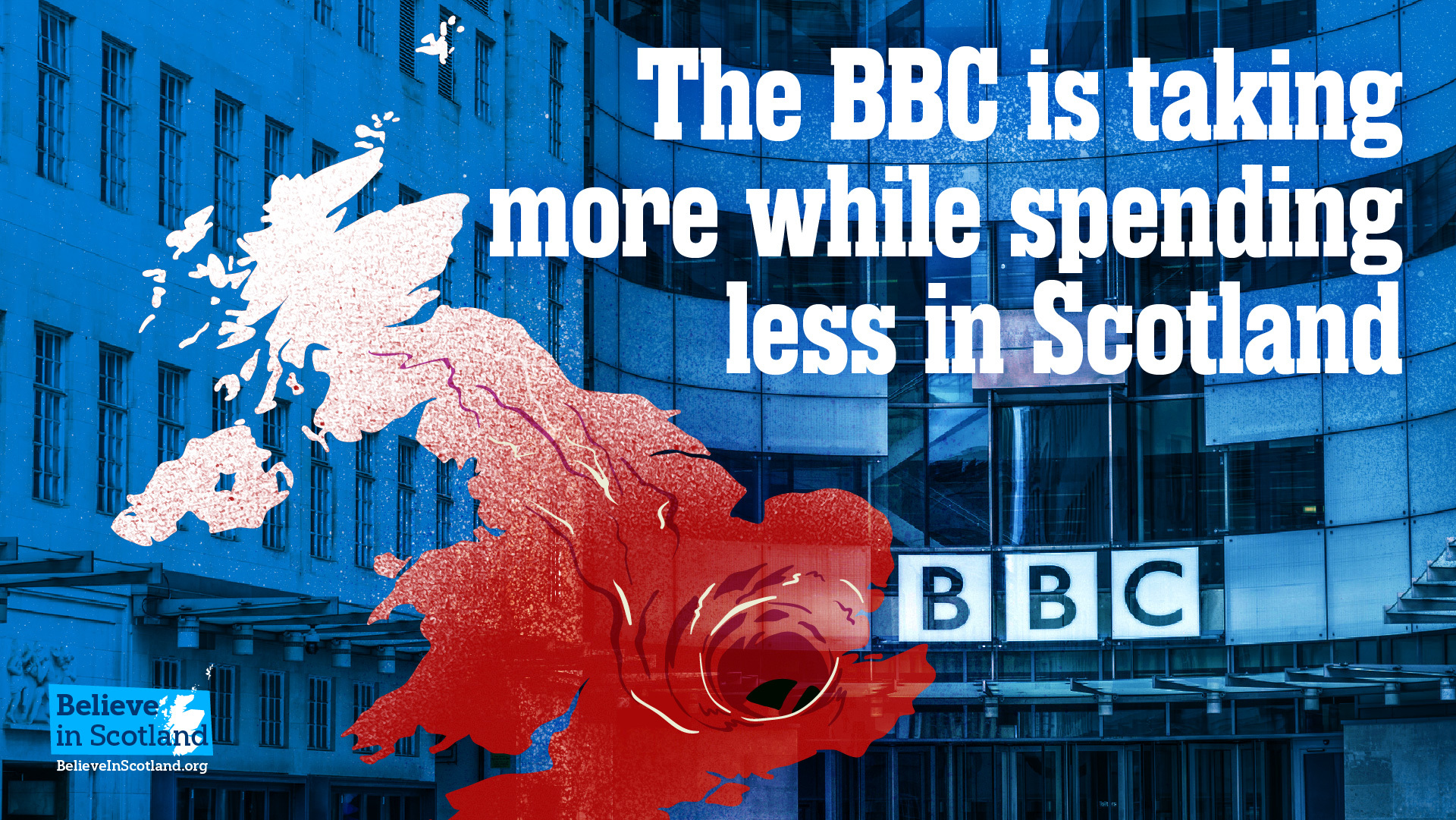
BBC Scotland is taking MORE in licence fees from Scottish households, whilst spending LESS in Scotland. Scotland has a much smaller media industry than other similar-sized independent countries. The siphoning of resources by a London-centric organisation is key part of that.
The licence fee is set to go up to £180 a year from April 1st. That means Scotland will be providing more than the £311 million it gave the BBC in 2024. The licence fee rose by a similar percentage last year, but Scotland is not getting the benefit.
The BBC spends around 70% more per head in England on producing TV shows as it does in Scotland. From 2023-25, network television spending by the BBC in England rose by 12%, to almost £1.4 billion a year. But, in the same period, its network spend in Scotland fell by £24 million to £81 million. That is a decrease of 23%.
Even the money the BBC claims to spend in Scotland is often used to make Scotland the backdrop. Flying in London crews and putting them up in hotels, as it does with The Traitors. That is very different from supporting Scotland’s media ecosystem or culture.
In a recent National article entitled “Public Service Broadcasting isn’t working for Scotland”, director Peter Strachan argued that unless the BBC is prepared to make meaningful structural reform, it will continue to drive inequality for Scotland. He accused London of eagerly “hoovering up” money earmarked to nurture Scotland’s creative industries.
The BBC has also been forced to issue corrections much more in Scotland than in other parts of the UK, because of framing news in a Unionist way.
With charter renewal coming, the BBC has said it will spend more in Scotland - but an independent country could use this money to nurture the depth and richness of Scottish talent and culture instead of leaving it to London-based executives to choose what to spend our money on.
Here are a few issues Scots have with the BBC
1 - Support for emerging Scottish artists has collapsed
Musicians are angry at BBC Radio Scotland’s decision to swap out the late-night curated music shows that nurtured emerging Scottish talent in favour of generic easy listening.
Singer-songwriters Iona Fyfe, Emma Pollock, Dean Owens, Findlay Napier, James Grant, Kim Edgar, Carol Laula and Kris Drever accused the publicly funded broadcaster of “cultural vandalism” after specialist music programmes hosted by Iain Anderson, Billy Sloan, Roddy Hart and Natasha Raskin Sharp were taken off air.
New research last month by the band Constant Follower, led by folk musician Stephen McAll, found that plays of music by independent Scottish artists collapsed.
Mr McAll went back through every late-night playlist from January 1 to 15 2025, pulling out every track and artist name, then did the same for the same period this year. From January 1 to 15 2026, compared to the same period in 2025, he found that the station became much less likely to play new tracks by Scottish artists. In fact, the numbers fell by a whopping two thirds.
The BBC responded with a blanket denial that there is an issue: "We don’t recognise these figures which appear to be drawn from a very limited view of a small part of the schedule.”
But that did not wash with many - folk singer Vivien Scotson posted on Facebook that she was selling her guitar. She wrote: “BBC Radio Scotland bosses have axed several important late night shows. Statistics show that if you are an independent Scottish musician, you’re now over 60% less likely to be played on BBC Radio Scotland, and if you are a female Scottish musician, you’ve got even less of a chance of being played on BBC Radio Scotland. My old guitar is for sale, and here is why”.
2 - Reduction in Scottish content across the board
Listeners to BBC Scotland may also notice that the new morning show “Radio Scotland Breakfast” is a lightly-regionalised magazine format with very little Scottish content, more like the presenter’s segments on Radio Two than a Scottish news and politics show.
Last week, its presenters were “stoked’ to speak to Giles Brandreth about old English words - a genuinely Scotland-based show might have looked at Scots words instead.
The following day, a major feature was 50 years of the Muppets, focusing on its early filming in London. There were no similar magazine segments about any Scottish cultural events.
BBC Scotland TV has axed “The Nine” and sought permission to reduce its news output. Last year, the long-running drama soap “River City” was axed, depriving its crew of stable jobs. Rather than replacing it with another long-running show with long-term jobs, the BBC is scattering the money.
Herald writer Alsion Rowatt castigated part of the replacement for this, a “crude” podcast called “Situationships” as cheap TV adding: “I don’t know who Situationships is for, and I’d bet BBC Scotland doesn’t have a clue either. The Holy Grail 18-25 cohort would find it laughable. It’s just another ill-considered leap into an already crowded market, one that risks dragging standards down further at a time when they have never been more important - to audiences and the BBC. Whatever future was imagined when the BBC Scotland channel was launched, it was surely not this.”
Seemingly in an effort to please London decision-makers, BBC Scotland does not allow or encourage the use of Scots or Gaelic in its shows - one example of this is the detective series “Shetland” (made by a London-based company). A Swedish family of characters was given subtitles. But Scots, or the Shetland dialect, is never used. There is one Shetlandic actor but he never uses Shetlandic words or phrases. Similarly, in Gregor Fisher’s sitcom “Only Child”, the characters don’t use Scots or Doric words.
3 - The biggest “Scottish” show “The Traitors” has few Scots in the crew
The BBC counts The Traitors' budget as Scottish spending on the grounds that it is filmed in a Scottish “castle”. But fewer than half of the production crew are Scottish.
BBC Scotland director Hayley Valentine refused to say exactly how many when giving evidence to a House of Commons committee. She said it had gone up by about 10. She conceded it was still less than half, and it may be much less than half. According to LinkedIn, the production company Studio Lambert employs just one person in Scotland, in Glasgow.
Last year, the documentary filmmaker Peter Strachan investigated and found that just 4.17% of above-the-line roles - creative, director, producer - are filled by off-screen talent based in Scotland. On below-the-line roles - that is day-to-day filming and editing and the like - just 6.25% are north of the border. Over 80% of the production team are based in London.
Adam Ramsay of Novaris Media wrote in a piece entitled “The Traitors is Fake Scotland at its Worst” that the image of the Highlands shown is the Victorian burned, silenced and environmentally devastated version. There is no interest expressed in the Gaelic or Scots language, traditional music, the remnants of the Caledonian rain forest. In contrast, the Irish version consistently integrates Gaelic words and phrases.
4 - Unfairness towards Scottish independence
BBC Scotland has issued more corrections regarding errors in the last three years than BBC Wales, BBC Northern Ireland and all regional English BBC bureaux combined.
In 2025, BBC Scotland errors included a June episode of Debate Night shown on the eve of the Holyrood by-election in Hamilton, Larkhall and Stonehouse, which had three Labour-supporting panellists out of five.
In another example, the BBC was forced to issue a correction in October after it echoed almost word-for-word a Tory press release claiming without fact checking that “over £1 million [had been] spent on sending Scottish ferry staff to Turkey”.
In fact, only £23,000 had been spent on the Turkish trips to monitor the construction of new vessels, with the remaining £1m being normal staffing costs over three years, which would have been paid regardless.
The BBC also made headlines after falsely claiming that one-third of Glasgow's schoolchildren are not fluent in English during a Question Time debate on comments made by Reform UK leader Nigel Farage. However, as this output was UK-wide, it was not included in the BBC Scotland error tally.
Then, this January, the BBC initially refused to correct misreporting on the Scottish Budget. It claimed that “more than half of workers in Scotland will pay more tax than if they lived elsewhere in the UK” The facts are the opposite: more than half of workers in Scotland will pay less tax than if they lived in England. After initially refusing to correct this, the broadcaster finally U turned.
In a Herald column entitled “The BBC has a serious Scotland problem, yet nobody is talking about it”, Herald columnist Neil Mackay wrote: “There seems to be something of a wall of silence when it comes to most media outlets picking up on concerns held by Scottish nationalists related to the BBC’s news output.”
5 - Other independent countries have much stronger film and TV sectors
Scotland’s film and TV sector has been valued at £700 million a year - that is far smaller than that of countries like Denmark and Ireland. Ireland’s annual media revenue is above 7 billion euros. Denmark does even better than Ireland with a 10 billion euro sector.
Why does Scotland perform so much worse in this important area? It is not because Scots are massively less talented and capable than people in similar-sized independent countries. It is because of that huge resources hoover mentioned by Peter Strachan.
Conclusion
Having a strong media ecosystem depends on nurturing Scotland-based talent over the long term and giving people the means to survive and thrive without feeling they have to move south.
BBC Scotland performs like what it is - a branch office of a London-based organisation without much commitment to or understanding of Scotland as a country with its own culture, history and linguistic heritage.
They don’t see the difference between servicing London and engaging with and supporting Scotland’s cultural and media ecosystem. They reject any attempt to make this point with blanket denials.
The Scottish government has raised its budget for culture. But the BBC license fee has also gone up. So the amount of money Scots hand over to the BBC each year is in the same ballpark as the entire culture budget of the Scottish government.
Scots have a right to expect that this money is spent not just on serving existing taste with generic offerings that could be made anywhere. It has to be about broadening the possibilities, engaging with the depth and richness of Scottish culture. That has to come from a place of knowledge and understanding and - on current showing - the BBC does not have that.
An independent Scotland could direct this money much more effectively - as neighbouring independent countries do.
