Lessons for an independent Scotland - Sweden
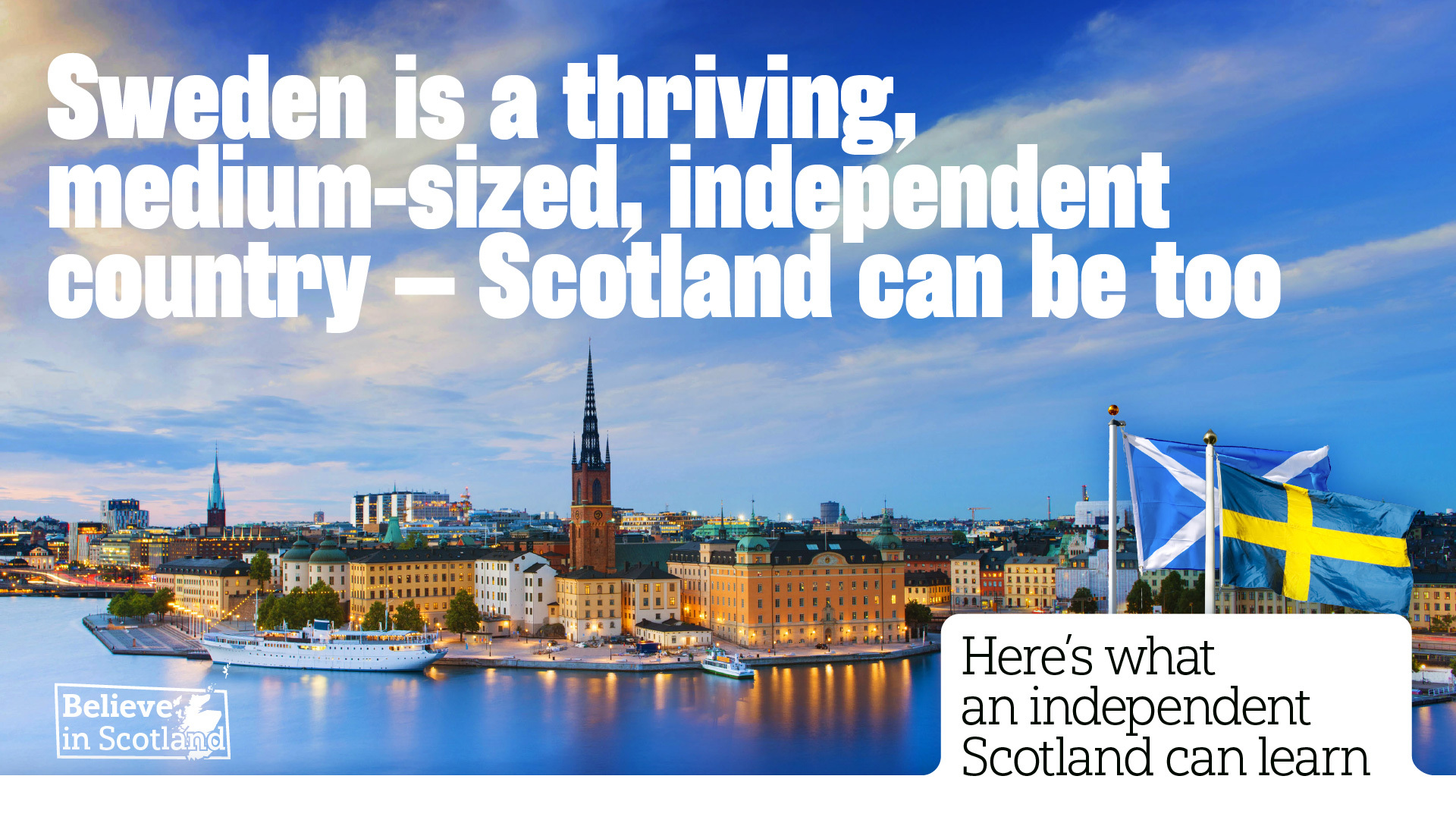
Sweden is the largest of the Nordic countries. It has a land mass of about 450,000 square kilometers which for context gives it a land mass of nearly three times that of the UK. The population however, is ten million making much of Sweden even less populated than rural Scotland.
Here we focus on two key lessons for an independent Scotland - how Sweden uses zonal pricing to turn energy potential into prosperity, and how Sweden manages its equity market to support investment in its strong export economy.
The background
Sweden was once part of a Union ruled by the Danish Royal Family. But, in the early 16th century, the Kalmar Union of Denmark, Sweden, Finland and Norway was ended by the Swedish Liberation War. Sweden became an independent country in 1523. Finland was part of Sweden at that time, while Norway was under Danish rule.
Two centuries later, in the early 19th century, Sweden was on the winning side in the Napoleonic War. It took possession of Norway, but it lost control of Finland to Russia.
In the early 20th century, when Norwegians demanded their independence. Sweden quickly reconciled to this idea and resolved the issue through negotiation. Sweden also supported Finland’s demand for independence from Russia.
Sweden managed to remain more or less neutral in both World Wars, though it was forced to make concessions such as exporting iron ore to Germany. It was not part of the Holocaust. Most Danish Jews and some Norwegians managed to take refuge in Sweden. Many Hungarian Jews were granted Swedish passports and enabled to escape when the Nazis invaded in 1944.
Initially, Sweden was sceptical of joining the EU because of its history of neutrality. But it became a full member in 1995, and is now fully integrated, although it does not use the Euro. It became a member of NATO in 2024, following the Russian invasion of Ukraine.
The Swedish krone is worth less than the Danish one and it operates via a floating exchange rate, which is a policy choice made in part because of Sweden’s strong export economy. Exports account for half of Swedens GDP. Key industries driving this success include engineering, automotive (e.g., Volvo, Polestar), telecommunications (e.g., Ericsson), pharmaceuticals, and sustainable technologies.
1 - Zonal pricing is part of Sweden’s energy management strategy
When Scotland becomes independent, it will inherit arguably the richest vein of renewable energy potential in Europe. Currently, under UK rule, Scotland is saddled with by far the highest levels of energy poverty in Europe, more than double England’s at 34%. Scottish families and businesses are forced to pay some of the highest bills in the world.
Meanwhile, fuel poverty rates in Sweden are among the lowest in Europe at around 3%. Scotland can look to Sweden for lessons in how to use energy policy to turn potential into prosperity and energy abundance.
Sweden has some similar challenges to Scotland: abundant, cheap hydro and wind in the north, heavier demand in the south, where much of the population is centred.
For years, Sweden operated under a single national wholesale price, like the UK. In 2011, Sweden changed course. It split the country into four bidding zones and allowed prices to reflect where electricity was plentiful and where it was scarce.
Electricity in the north became much cheaper and sometimes negative. It is among the cheapest in the world. As a result, Northern Sweden is attracting energy-intensive businesses.
There have been set-backs. The current centre-right government has reduced support for green energy and Northvolt, which was attempting to challenge Chinese dominance of the EV battery market, went bust. A buyout by US firm Lyten is under way but taking longer than anticipated. But the world’s first large green steel mill is under construction and last month it announced a major EU-funded hydrogen project.
Sweden’s decision to change its energy pricing market is innovative, dynamic and pragmatic. Sweden’s reform was possible because the transmission backbone is publicly owned and operated by Svenska Kraftnät. The state controls the grid. The state decides how congestion is managed. Sweden has accepted that businesses should be encouraged to set up closer to the sources of cheap energy with pricing signals.
It is not without issues - zonal pricing makes electricity more expensive in the south, where the state can direct support for households that need it. But the old system involved constant behind-the-scenes intervention by the systems operator and a distorting effect on investment decisions.
If electricity is abundant in one region and demand sits elsewhere, you either price that constraint honestly - or you try to bulldoze your way out of it with infrastructure. If you simply try to ignore the geography, then you are effectively saying that the only way this power can be used is if lines of huge pylons are put in place to move it south.
That is the road that the UK has set Scotland on. In practice, it will require years of planning battles, local opposition, huge capital expenditure and constraint payments when bottlenecks cannot be overcome.
A different model would involve businesses and households making use of the energy when it’s abundant and even storing it locally. Hydro is Sweden’s biggest storage mechanism - of course Scotland was once a world leader in hydro but for more than ten years, the UK government has declined to set a market framework that would allow Scottish hydro plants to be built.
Only with independence can Scotland make energy work for Scotland’s people and businesses, as Sweden does.
2 - Structuring a strong equity market
An independent Scotland would have its own equity market - an important strategic instrument of national prosperity. Sweden’s equity market is one of the most successful in Europe, quite an achievement for a country of 10 million on the periphery of the continent.
A strong equity market does not simply reward savers, it builds businesses. Sweden’s capital markets provide growth capital to engineering firms, automotive innovators, telecoms giants and green technology companies that drive its dynamic economy.
Edinburgh remains one of Europe’s most significant centres for asset management. Firms such as Baillie Gifford and Scottish Widows manage hundreds of billions in global assets. But Scotland's equity market was subsumed by London in the 1970s and without independence Scotland does not have the power to shape its own equity market.
Scotland is tied to the UK”s drift. Since Brexit, London has slipped from one of the top financial markets in the world to number 23 in terms of the value of IPOs. When London lost frictionless access to the European market, it weakened one of its biggest advantages.
Sweden shows a different model. The Stockholm exchange, operating as Nasdaq Stockholm, serves a population of just over 10 million yet sustains a remarkably deep domestic equity culture. Verisure, the Swiss/Swedish security group, which looks set to be Europe’s biggest market debut since Porsche in 2022, is planning to go with a Stockholm listing, instead of the London Stock Exchange.
According to Fondbolagens förening, the local fund management association, fund investment is more popular in Sweden than anywhere else in the world, with eight in 10 Swedes invested in funds. A thriving pensions market provides ready anchor investors for Swedish initial public offerings.
At the end of 2023, according to the OECD, there were 3.8mn unique dedicated investment savings account (ISK) holders, in a total population of 10.6mn. Sweden’s success is the result of long-term strategy and planning. The report looks at policy incentives including tax free investment allowances introduced in the 1970s and steps since then to encourage Swedes of every class and organisation to build their savings into investments. Equity ownership is not confined to institutional elites in Sweden; it is woven into household financial life. AstraZeneca, for example, trades in London and New York but retains a listing in Stockholm, where it has a substantial base of nearly 170,000 Swedish shareholders.
Pension funds act as long-term anchor investors in domestic listings. Savings are channelled toward productive enterprise rather than disproportionately into property speculation or cash savings. Over decades, that architecture has built internal capital depth.
Recently, Euroclear’s Nordic transformation programme has unified the Swedish and Finnish central securities depositories on a common platform, aligning Nordic markets with European standards and strengthening the ecosystem.
Returns have been impressive. Nasdaq figures suggest that over the past half-century or so, Swedish returns actually outstrip any other major market, delivering an 8.2 per cent total return, compared with 5.9 per cent for the US and 5.8 per cent for the UK.
Scotland’s economic future (renewable energy, advanced manufacturing, life sciences and digital technology) will require investment. Sweden demonstrates that small nations within the EU can cultivate mass shareholder participation, strong domestic anchors and modern market infrastructure.
Conclusion
Sweden shows what sovereignty looks like when it is used with purpose and for the benefit of the people and Scotland as part of the UK lacks that sovereignty. Sweden manages its energy, its capital and its export economy as connected parts of a national strategy focused on enhancing national wellbeing. An independent Scotland could do the same - and turn its immense potential into prosperity for the Scottish people.
