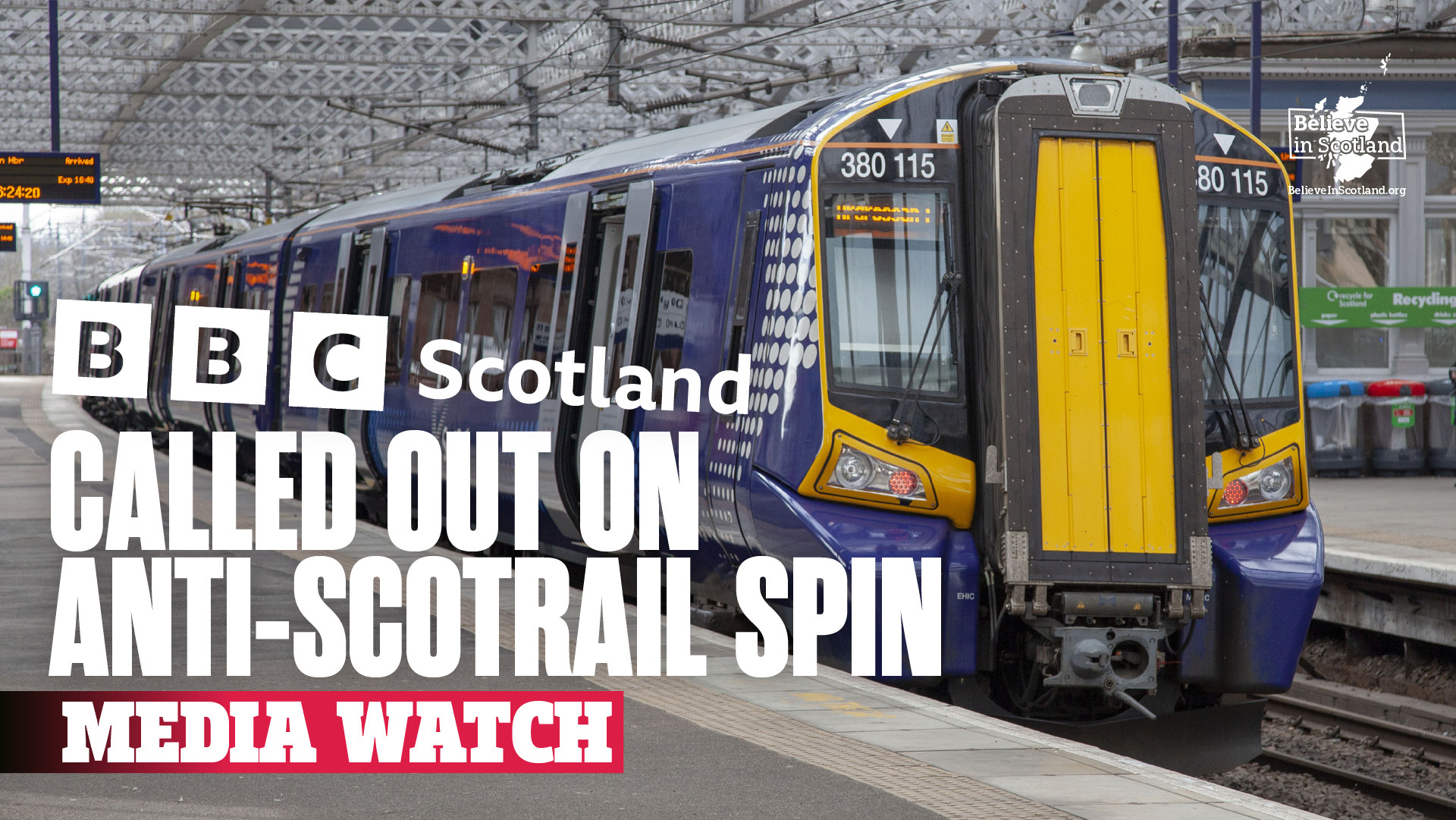
Media Watch: BBC Scotland Called Out On Anti-Scotrail Spin
BBC Scotland slapped a photo of Edinburgh Waverley above the headline “Britain’s worst major train stations for cancellations.” The unmistakable visual cue: Scotland = worst.
Except it isn’t.
Every Scottish station, and Scotland as a whole, did better than the UK average. Scotland had the lowest cancellation rate of any UK nation by a significant margin.
Add to that the recent scrapping of peak fares, which makes rail travel materially cheaper here than in the rest of the UK, and the picture painted by that headline-image combination was the opposite of reality.
When the Scottish government took Scotrail back into public ownership in April 2022, the Unionist parties and their media mouthpieces sneered - calling it “Natrail”. They produced memes - here is one from Scotland Matters - which was splashed in the Daily Express. 
Now three years later, when Scotrail is doing better than English franchises, the issue for many Scots is - why is the success story of Scotland’s publicly owned rail service not deemed newsworthy by any outlet except the National?
Hands up who thinks that would have been different if Scotland had been doing worse than England?
The false framing called out
“Scotland has the lowest percentages of train cancellations in GB and Edinburgh has amongst the lowest percentages of any major city. How on earth can @BBCNews be presenting these FACTS online with the image below? It's totally misleading, false and must be corrected immediately.”
They’ve since swapped the image to an Edinburgh departure board better than Waverley’s facade, perhaps, but still “Scotland as the face of ‘worst’,” despite Scotland bucking the trend.
The BBC responded that it was a UK wide story which had simply been illustrated for Scottish readers online. But put a Scottish station under “Britain’s worst” and thousands of casual readers will take away “Scotland’s trains are terrible,” even if the copy quietly contradicts it.
Attacking Scotland to please the man
There is a general media tendency towards “bad news bias”. But that is amplified by the nervousness that positive Scotland headlines might look like advocacy.
That means that people who work for news organisations with a Unionist mindset tend to self-censor.
They want to please the boss, they want to get promoted. And putting the boot into Scotland often seems the best course.
The problem is also that there is no space to look at the positives of the publicly owned service
Transport Secretary Fiona Hyslop commented on X:
“BBC Scotland headline with picture of Edinburgh Waverley could have been ‘Scotland has lowest % of train cancellations in UK'. Not difficult but perhaps explains why BBC Scotland’s own viewing and trust performance figures are one of the worst in the BBC across the UK.”
The BBC annual report from July 2025 showed the number of Scots who feel the BBC is effective at informing, educating and entertaining people in Scotland and the rest of the UK fell three percent, from 64% in 2023/24, to 61% in 2024/25. In the same period, the number of people who ranked it ineffective rose from 15% to 17%.
The figures were the worst in the UK, including all the English regions, apart from Northern Ireland.
What the data shows: cheaper fares and higher customer satisfaction
The removal of peak fares earlier this month has made rail travel cheaper here than in much of the rest of the UK.
A day return from Glasgow to Edinburgh which is 45 miles costs £16 - a day return from London to Reading which is about the same distance costs £36 according to the Trainline app.
Scotrail reported an overall customer-satisfaction rate of 91% earlier this year.
Since public ownership in April 2022, ScotRail’s reliability has been better than the UK average. It has a cancellation rate about a quarter of those of Avanti West Coast and CrossCountry, whose recorded cancellation rates in 2023-24 were around 7 per cent and 8 percent
The Office of Rail and Road data for last year found an average UK cancellation rate of 3.3%. Scotland’s rate was 2%, the best in the UK. England and Wales ran at 3.5% and 3.9% respectively. City Thameslink in London was the single worst major station.
Zoom in on Scotland and the “worst” examples are still better than average: Glasgow Exhibition Centre topped the Scottish list at 2.8%, Several major Scottish stations achieved a cancellation rate of under 2% including Aberdeen, Dundee, Glasgow Central, Queen Street, and Stirling. The lowest was Paisley Gilmour Street at 0.7%
Edinburgh was just on two percent, which makes putting Waverley under a “worst” headline look like, at best, sloppy picture editing – and at worst, a narrative hunting for an image.
Conclusion
If Scotland’s publicly owned rail service is cheaper at the point of use, more reliable on cancellations, and well-rated by passengers — and still gets framed as “worst” — that tells you something bigger than one headline.
But the numbers refuse to vanish. When Scotland takes the levers - as with ScotRail - outcomes can improve. That’s the quiet case for independence: competence, accountability and alignment between what Scotland votes for and what Scotland gets.
