Scots charged extra to access Scotland’s energy
There is an ongoing and serious injustice impacting Scottish energy consumers and The Westminster Government does not give a damn. That injustice is called 'Electricity Standing Charges' and it's essentially a tax that is added to your electricity bills just to connect you to the grid.
However, not every part of the UK pays the same standing charge, because the system is designed (as with most UK systems) to give an advantage to larger English population centres. In Northern Scotland the electricity standing charge is 62p a day (£227.00 per year), in London it is 47p a day (£172.00 per year). That is an extra £55.00 per year, before a Scottish household has used a single unit of electricity. Now, Scottish households having to pay around half a billion in Standing Charges every year is one thing but if Scotland had the same standing charge as London in 2025, Scottish consumers would have saved around £109m a year. That is £109 million ripped out of Scotland’s economy, straight from the wallets of ordinary people. *1
Despite Scotland being an energy rich nation, Scottish households have to pay more just to access electricity that is generated in Scotland, than most people in England do.
The only UK area to pay more than people in Northern Scotland are those in Northern Wales - and that is another location rich in onshore windfarms and hydro power. However, most people in Wales live in South Wales and pay lower standing charges than those in Northern and Southern Scotland. Some Welsh towns also fall into the even cheaper Midlands standing charge area. So you could make the point that a weighted average means Scots pay more than Welsh households overall but the better point to make is that London controlled policy will always work against the best interests of both Scotland and Wales and against rural areas in particular, where more and more of the UK’s vital renewable energy supplies originate. It's not so much a broken system, as one that was designed to disadvantage Scotland and Wales.
Extortionate UK Energy Costs
On top of that, being part of the UK energy market means Westminster sets the price of energy and that means Scottish households are paying for a failed UK energy system made more expensive due to dependency on imported gas and white elephant nuclear projects when an independent Scotland's energy market based on renewables would cut costs by between a third and half. Now, I know Westminster politicians will say that is impossible but there is indisputable hard evidence that an independent 5.5m population energy rich nation can deliver way more than the one third saving suggested above.
Norway electricity prices versus the UK
- UK electricity standard unit rate: 27.69p per kWh
- Norway household price (rough GBP equivalent): 9.8p per kWh
Note that Norway does not have standing charges, (because it wants to encourage the rural economy!) has consumer energy prices that are roughly one third of the UKs - and is rolling out an energy subscription service that lowers Norway to almost one tenth (3p) of the UK price to help Norwegians with the cost of living.
Even allowing for different taxes, tariffs, and market structure, that demonstrates that Norway acts like an energy nation that prices power for domestic resilience, not a community wealth extraction system like the UK.
Real hardship
In 2022, Scotland’s net exports of electricity had an estimated wholesale market value of £4.0 billion. Yet Scotland has experienced around 980,000 households (39%) living in fuel poverty (unable to afford to heat their homes) at points in recent years
Lets be clear - Scotland is an energy rich nation and energy rich nations should not have people who are living in fuel poverty.
What standing charges are, and why they punish Scottish households
Your energy bill has two parts:
- Unit rate - what you pay per kWh you use
- Standing charge - a daily fixed fee you pay even if you use no energy at all
Ofgem explains that the standing charge covers things like the cost of maintaining the network, metering, and some wider policy costs. So, you are being taxed to maintain the power grid when the power grid is privately owned and so are the electricity supply companies, who in recent years have been declaring eye-watering profits and underinvesting in the grid in particular. The key point is that standing charges are a fixed charge, so it hits low usage households hardest, and it hits fuel poor households hardest of all. If you self-ration your heating because you cannot afford it, you still pay the standing charge every day.
Citizens Advice Scotland has been blunt about the impact: regional variations in standing charges disadvantage Scottish consumers and act like an extra premium on rural communities.
The Scotland problem: colder, older, more off-grid
Scotland gets clobbered by this set-up for three structural reasons.
First, UK policies have for generations led to slow population growth and even population decline. As a result, Scotland tends to have older, harder to heat homes. The Scottish House Condition Survey estimates around 455,000 dwellings were built before 1919, roughly 19% of the housing stock.
These homes are more likely to be leaky, solid-walled, and expensive to retrofit properly. But they often look amazing.
Secondly, Scotland has more homes off the gas grid. The data from the UK Parliament’s House of Commons Library shows that Scotland at about 19.1% of households are not serviced by the UK gas grid. Those households are forced onto more expensive heating options like oil, LPG, or electric heating. When electricity standing charges are higher, that is a direct penalty on people who often have no realistic alternative.
Thirdly, Scotland is colder on average, so heating your home is not optional for long stretches of the year. That is exactly when households are most exposed to fixed daily charges, because the standing charge is there before you have even turned anything on.
Standing charges by region (what you pay for electricity before using a single unit)
Ofgem is the UK Govenrmenet energy regulator and its tables set out the standing charges and unit rates by region and payment method, and the standing charge is the maximum a supplier can charge a customer who has not used any energy.
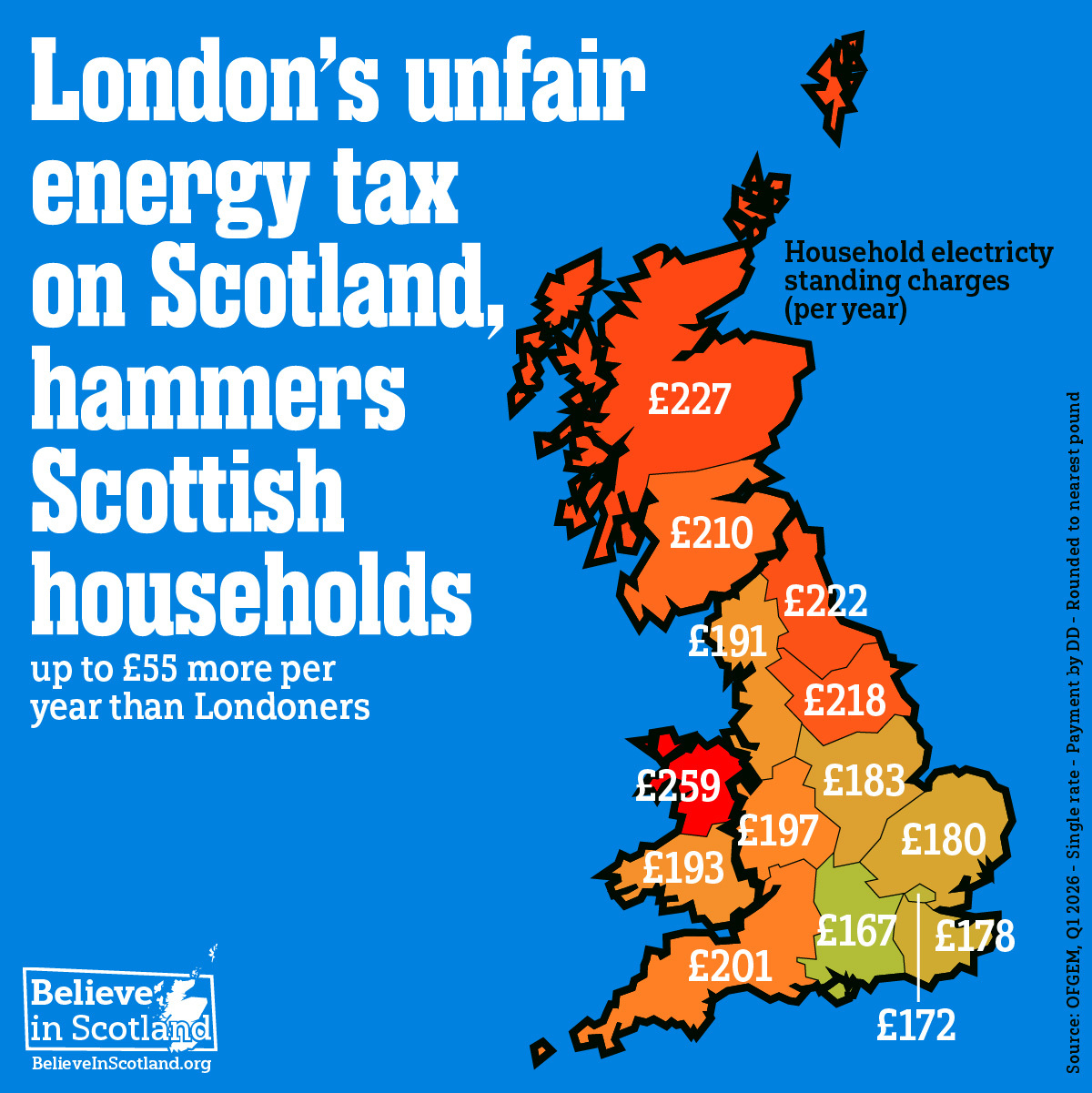
Northern Scotland vs London is a difference of about 15p per day, which is about £55.00 per year, even if you use little or no electricity.
So we have a system where households in Scotland, including our most productive energy producing regions, pay more just to be connected.
The official excuse: distance and network costs
The standard justification is that it costs more to run networks in rural areas and over long distances. There are fewer customers per mile of wire, more exposure to weather, and more need for reinforcement.
But here is the question Westminster and Ofgem avoid. If generation is increasingly in rural Scotland, and major new grid investment is explicitly designed to move Scottish renewable power south, why are Scottish regions treated like a problem cost rather than an asset?
Indeed when standing charges were originally set they were costed on how far households were from the now defunct English midlands and north west coal fired power stations - but now the areas paying the lowest standing charges are the furthest from the onshore wind turbines that many northern Scottish householder can actually see out of their windows.
Two major HVDC links illustrate what is really happening. Eastern Green Link 2 is a 2GW subsea HVDC “superhighway” from Peterhead to Drax in Yorkshire, built to move Scottish power to where demand is. Eastern Green Link 1 similarly links Torness in East Lothian to Hawthorn Pit in County Durham.
Meanwhile, Scotland’s onshore transmission network is owned and run by SSEN Transmission in the north and SP Transmission in the south. The power flows are planned for export, Scotland doesn't need that energy for its own domestic use but the fixed costs / standing charge taxes are loaded onto the place the energy comes from - it looks like stupidity but it's not stupid, it's deliberate, it’s the Scottish Energy Bill-Rip off!
This is the UK's 'extraction economics' in action, another example of the UK government's policy of extracting value from Scotland, then adding the costs back on the people.
What needs to change
We should be clear about the goal. We want rid of unfair standing charges. You are not powerless though, you can join our campaign and sign our petition as we call call on the UK Government, and its UK regulator ‘Ofgem’ to:
- End unfair extra standing charges for Scottish consumers.
- Deliver a fair, transparent energy pricing system that does not harm Scotland's economy.
- Provide a pricing benefit that recognises Scotland’s massive contribution to clean energy generation.
- Publish a plan, with committed dates to lower energy bills for Scottish domestic and business consumers.
- Cancel all new energy price rises planned by the regulator in 2026.
What makes this petition worth signing?
When you sign this petition, your signature triggers an email that will be automatically sent to your MSPs and MP urging them to support this campaign.
Scotland can lead on renewables, on a just transition to a greener fairer and less expensive energy rich nation. But until we fix the charging model, we will keep exporting clean power while importing fuel poverty - the UK Government will reject our ask for sure but we expect a majority of Scottish MSPs to sign our petition and that will demonstrate clearly that energy prices will be significantly lower in an independent Scotland.
*1 Figures effected by standard rounding practices.
