Westminster wants to force nuclear sites on Scotland to supply England’s energy
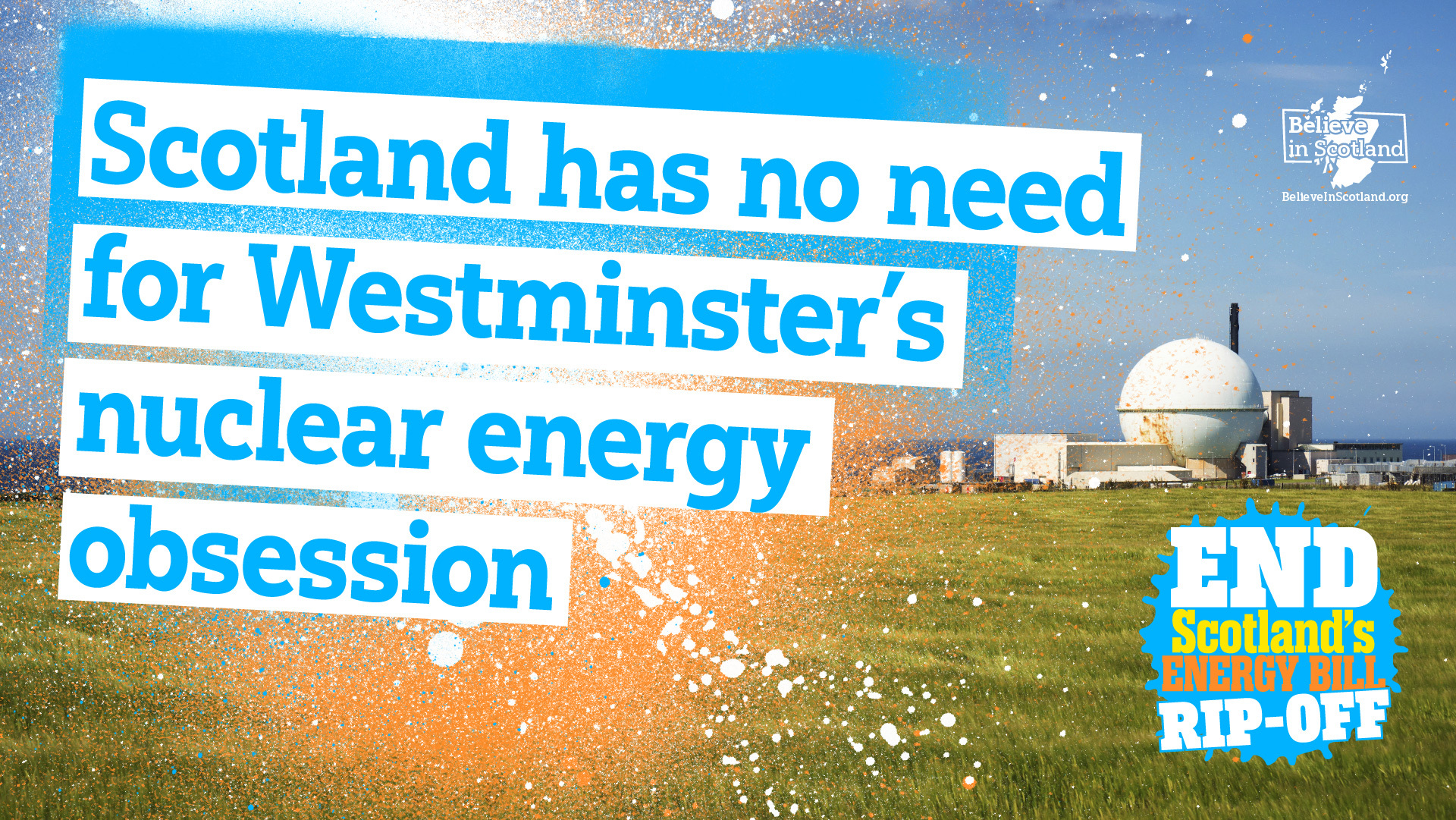
Scotland already has the capacity to produce more electricity than it needs - yet Westminster wants to turn our countryside into a nuclear export zone for England.
Energy Secretary Ed Miliband has instructed GB Energy to start scouting Scottish sites for new nuclear power stations. Torness and Hunterston have been named.
Read our previous article GB Energy is a Lie.
But Scotland’s government has said a hard “no” to new nuclear plants for decades. The Scottish public has never voted for it. Yet here we are again - London ordering up sites north of the Border for a policy Scotland doesn’t want, need, nor benefit from.
- Scotland already generates more renewable electricity than it consumes. The equivalent of 113 % of our gross electricity demand was produced by renewables in 2022, and production is going up
- In 2023, a third of the electricity Scotland produced was exported, mostly to England, with a net export of 15.9 terawatt-hours, worth roughly £1.5 billion.
So if Scotland is already a net exporter of clean power, who exactly is this new nuclear capacity for? Certainly not for Scottish homes or businesses.
The answer is obvious: it’s for England - and so Scotland is expected to host the reactors, take the environmental risk, and watch even more pylons march across our landscape to feed a southern grid.
Now to be clear, exporting energy is a huge opportunity for an independent Scotland but:
- Scotland is keeping the UK’s lights on and in return we are paying three maybe four times what we should for energy.
- Scottish businesses pay the world's highest commercial energy costs
- 31% of Scottish families are left in fuel poverty.
- All of that represents the cost of remaining in this dysfunctional union where the distant Westminster government only views Scotland as an asset to be milked.
An out-of-date idea designed for someone else’s priorities and profits
The argument by the nuclear lobby that a renewables-based grid needs a nuclear “baseload” for when the wind doesn’t blow is out of date. Experts agree that a renewables-based grid needs a flexible top-up that can be turned on and off as required.
That doesn't need to be nuclear. Even if a new design enabled it to be turned on and off the sunk costs of construction make that an unworkable idea. So when the wind blows we would have to spend even more public money on turning off wind turbines instead.
Scotland could use pumped storage hydro as a flexible top-up for a clean energy grid - which would work much better for our conditions. Scotland used to be a world leader in hydro but no longer. Despite the Scottish government awarding planning permission to several projects over the last decade nothing is getting built.
That’s because private companies need a market framework before they can invest and the players who control UK energy policy don’t want that. Things like nuclear power are going to be much more profitable for them. So Coire Glas, the biggest project is still swinging in the wind with not a shovel in the soil because of the Westminster’s Government's unwillingness to address issues with its own market framework.
Meanwhile, Norway has developed huge pumped storage hydro capacity which it uses as a cheap way to stabilise and top up its renewables-based network. Norwegian hydro is set to become an anchor for the energy grid across Europe.
The Scottish government has no control over Scottish energy
Energy in the UK is a reserved power, meaning decisions on generation, pricing, and investment sit with Westminster.That means:
- Holyrood cannot design a pricing system that reflects Scotland's renewable potential.
- It cannot require new projects to reinvest profits locally.
- It can only give planning permission for hydro - it can’t ensure any project gets built
- It cannot stop GB Energy’s budget from being quietly diverted into nuclear projects Scotland doesn’t want nor need. (GB Energy as we wrote earlier in this series was a pitch and switch at the last general election - Scotland got the logo. England got the money.)
The export nation
Scotland’s renewable sector has been one of the quiet success stories of the past decade. Offshore wind, hydro, and tidal generation have turned the Highlands, Islands and North Sea into the engine of Britain’s clean energy future.
There is a cost to local populations in construction caused disruption and unsightly pylons but they don't just not get any benefits or compensation for this - instead they are penalised. Households and businesses in these areas don’t have access to the gas grid and pay twice the UK average for energy bills. Producers also are charged higher costs to connect to the grid.
But follow the money - it doesn’t stay in Scotland.
UK governments that Scotland didn’t vote for privatised the energy system. Electricity generated in Scotland is sold by private energy firms like SSE (whose biggest shareholder is Black Rock venture capitalists) to the UK Energy Systems Operator ESO.
- The money goes first to the energy companies, not to Scotland.
- Taxes on their profits are paid to HM Treasury, not Holyrood.
- The Scottish Government has no fiscal lever to capture the value of what’s produced here.
The output counts towards Scotland’s GDP, but the revenues and tax receipts stay in London and are controlled by London. It’s a statistical illusion that flatters the UK accounts and deflates Scotland’s potential.
Nuclear power: someone else’s gamble
Now Westminster wants to repeat the same pattern with nuclear power — public risk, private and often foreign profit.
Take Hinkley Point C in Somerset, the UK’s flagship reactor. It’s being built by EDF Energy, a company owned by the French state, alongside China General Nuclear Power Group (CGN), which holds a 33.5 % stake. In other words, when Hinkley eventually starts producing electricity - at double the cost of renewables - a chunk of the profits will flow to the French and Chinese governments.
The cost of Hinkley has ballooned from £18 billion to more than £46 billion. It is years behind schedule. And yet, instead of learning from that fiasco, Westminster’s new plan is to push smaller versions of the same reactors onto Scotland.
The costing of nuclear power generation doesn't include the multi-billion pound clean up operation - The UK Government still spends £3 billion a year keeping Sellafield, formerly known as Windscale, safe.
The idea that the UK’s nuclear push benefits Scots is absurd
The power will be exported south. The profits will go to multinational or foreign-state energy firms. The Scottish Government, which controls planning, will be pressured to approve developments it fundamentally opposes.
Meanwhile, the real barriers to a stronger Scottish energy system remain unaddressed: a weak national grid, the absence of market frameworks for hydro storage, and the lack of zonal pricing that would make Scottish electricity cheaper where it’s produced.
That’s where investment should go - not into reactors Scotland neither needs nor wants.
We provide the land, we take the risk, we host the pylons: others take the benefits and we pay more for our own energy than others elsewhere in the UK.
It’s the Union as usual. Westminster decides the policy, sets the spending priorities, and captures the proceeds. Scotland provides the land, resources, and labour, but we don’t get any say in how the value is used.
We saw it with oil and gas, we’re seeing it with renewables, and now nuclear is next in line.
The Union works like a siphon: value generated in Scotland flows south, while the costs and environmental impacts remain behind.
