What can an independent Scotland learn from Estonia?
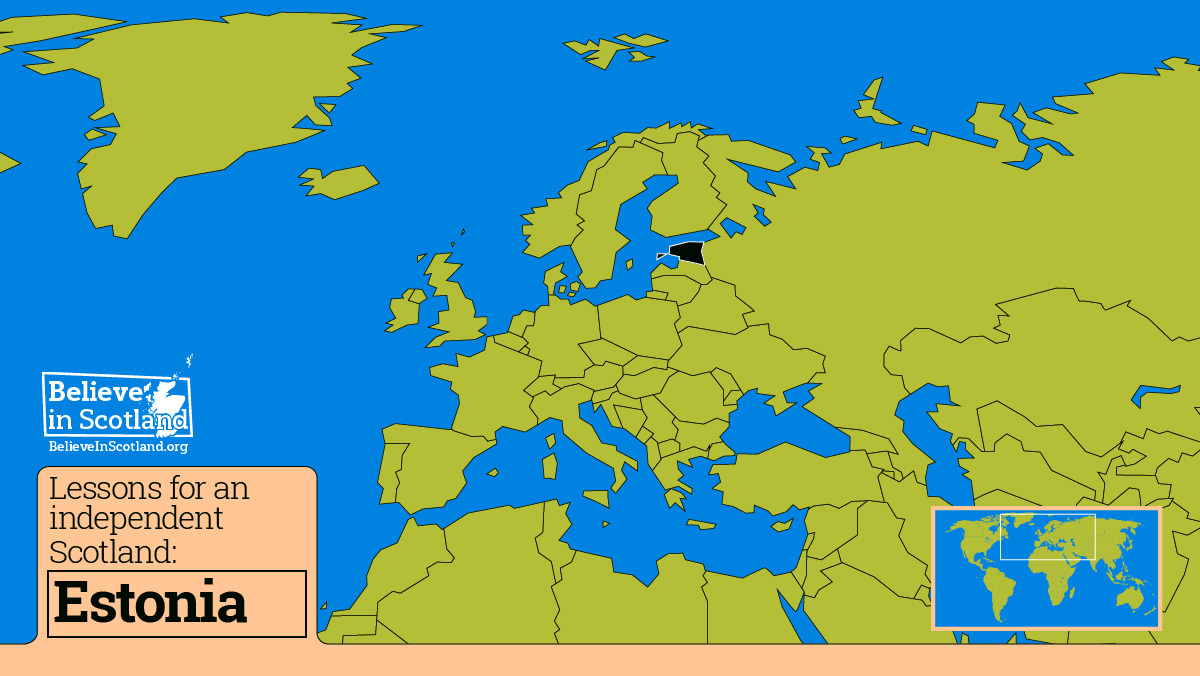
Estonia has a population of 1.4 million and the landmass is a bit more than half of Scotland’s, so it has a very low population density. It is one of Europe’s most forested countries with more than half covered by trees, where wolves roam freely. The wolf is the national symbol of the country.
It has also become famous as a digital-first state where you can do everything from making a dental appointment to getting divorced by mobile app.
It has also fostered an enviable tech sector - Estonia has produced 10 ‘unicorns’ - start ups valued at $1 billion - Scotland has produced just three.
Below we pick out a couple of lessons that an independent Scotland could learn: building a digital state and success in the tech-based economy.
The background
Estonians celebrate Independence Day on February 24. This recognises the first time Estonia emerged as a country in 1918, a century or so after the first national Estonian movement, which was organised around the language, started to appear. It was then swallowed up by the Soviet Empire during the Second World War.
In the late 1980s, the Singing Revolution of cultural resistance and demonstrations began and in 1991, Estonia became independent again. At that point, Estonia had to rebuild its state and economy from scratch.
They did that very successfully. Average wage growth has been strong. Life expectancy in Estonia has grown faster than in any other EU country over the last three decades and is now an average of 79.5. In education, Estonia is the top-performing country in Europe in the international PISA tests, and a global leader in maths and science. About 80% of Estonians own their home compared to 60% of Scots. Estonia is a member of the EU and it has benefited from the support of EU funds to build its new infrastructure. It uses the Euro.
It is also a member of NATO. It is only about 240 miles by road from the capital Tallinn to St Petersburg. Because of its Russian border, Estonia hosts one of NATO’s Enhanced Forward Presence battlegroups. A UK-led multinational battlegroup is based at Tapa in northern Estonia.
Estonia has more deaths than births. Without immigration, they would have a sharply falling population. Roughly 15% of Estonian residents were born abroad. Yet while it’s relatively easy to come to Estonia to live and work, it is much harder to become Estonian: naturalisation usually demands eight years’ residence, language exams and a civic test. The model is ‘high-immigration, strict-citizenship’ - a combination Scotland could consider when it takes control of its own immigration system.
1 - The digital state
After it emerged from the Soviet Union, Estonia built a low-hierarchy civil service with strong technical competence. Estonia’s digital state was architected in-house and then built with a tight ecosystem of mainly domestic tech firms, rather than outsourced wholesale to a single big IT vendor.
- The state kept control of the ‘brain’ - the standards, ID system and data layer - and treated private suppliers as partners plugging into that framework, not as owners of the system itself.
- They had a chief architect with the power to make sure there was a joined-up approach rather than a lot of siloed systems.
- Digital ID for everyone, legally robust, used for public and private services.
- A common data exchange layer (X-Road) so different bits of the state talk to each other
- “Once-only” principle: the state is not allowed to ask you for the same information twice.
- All Estonian citizens legally own their own data
Now Estonia is widely regarded as one of the world’s most digitally capable nations, having led the way in e-government and secure digital ID systems that support almost every part of daily life. Everything from voting and medical records to routine public services runs through this digital infrastructure, which includes a mobile app to ensure accessibility.
Last year, Estonia ranked 1st in the EU for digital public services, i.e. e-government. It also ranked 7th in terms of the digital economy, not bad for a small country at the periphery of Europe.
As cybersecurity and digital sovereignty move to the centre of global politics, Estonia’s experience offers valuable guidance for countries trying to balance openness, ease of access, and safety.
2 - Tech success
After independence, the country made a deliberate decision to build a digitally native economy, and the results have been extraordinary for a nation of just 1.4 million people. It now consistently ranks among Europe’s top start-up hubs, producing more unicorns per capita than almost anywhere in the world. The early success of Skype became a catalyst: the wealth, expertise and confidence it generated seeded new ventures such as Wise, Bolt, Pipedrive, Playtech and a long tail of fast-growing digital firms.
A dense ecosystem of engineers, founders and investors emerged, supported by a state that prioritised digital infrastructure, open data, and low administrative friction. Crucially, Estonia’s government and tech sector work in tandem - the state provides the digital rails (ID, signatures, registries, X-Road), while private companies innovate on top of them.
An innovative programme to attract talent called E-Residency builds on this foundation. By allowing global entrepreneurs to establish EU-based companies entirely online, Estonia effectively turned its digital state into an export product, attracting over 120,000 e-residents and helping to create more than 34,000 new firms.
In doing so, Estonia broadened its economic reach beyond its small population, drawing in foreign talent, investment and ideas without relying on large-scale physical immigration. The strategy reinforces Estonia’s image as a technologically focused, agile nation.
This outward-facing approach is underpinned by a strong education system and a cross-party belief that economic survival depends on enterprise. Estonians want their country to stay open to ideas, people, and global markets.
Conclusion
Estonia shows how a nation after gaining its independence can use the challenge of rebuilding institutions as an opportunity. They created a digital state that is accessible for everyone and has been the basis for improving outcomes in health and education.
They have empowered skilled public servants to make decisions and create a coherent system that works as a whole rather than with lots of siloed bits. They then used this digital capability to open doors for economic growth.
Estonia also reminds us that immigration, talent attraction and strong links to the wider world are not optional extras for small nations that want to compete.
An independent Scotland will have its own choices to make. But Estonia’s experience offers a powerful reminder that with focus, openness and a willingness to adapt, a small country can not only survive but thrive.
