2025 Movement Survey Results: How Should an Independent Scotland Select its Head of State?
Our 2025 Big Indy Movement Survey confirms that support for a Scottish Republic is strong among independence supporters but how should an independent Scotland's Head of State be selected?
In July 2025, Believe in Scotland ran its annual Big Indy Movement Survey and a record 7,226 Independence supporters responded.
We already know that support for the monarchy has fallen in Scotland since the death of Queen Elizabeth. And In late 2024, Believe in Scotland commissioned a poll, conducted by Norstat, which showed that the option of an independent Scotland that is also a Republic pushes support for independence up 5 points from the basic Yes/No question.
It is clear that if Scotland were to become an independent country (a fresh start) the majority of Scottish people would not want to take with us such arcane institutions as the monarchy (or House of Lords).
So it was no surprise to us that the 2025 Big Indy Movement survey showed independence supporters are not in favour of keeping a monarch as head of state as we have now. But what should replace the monarchy when Scotland achieves its independence? It seems the preferred option is to have an elected head of state as well as a First Minister.
Less than one in ten want to continue with the monarchy
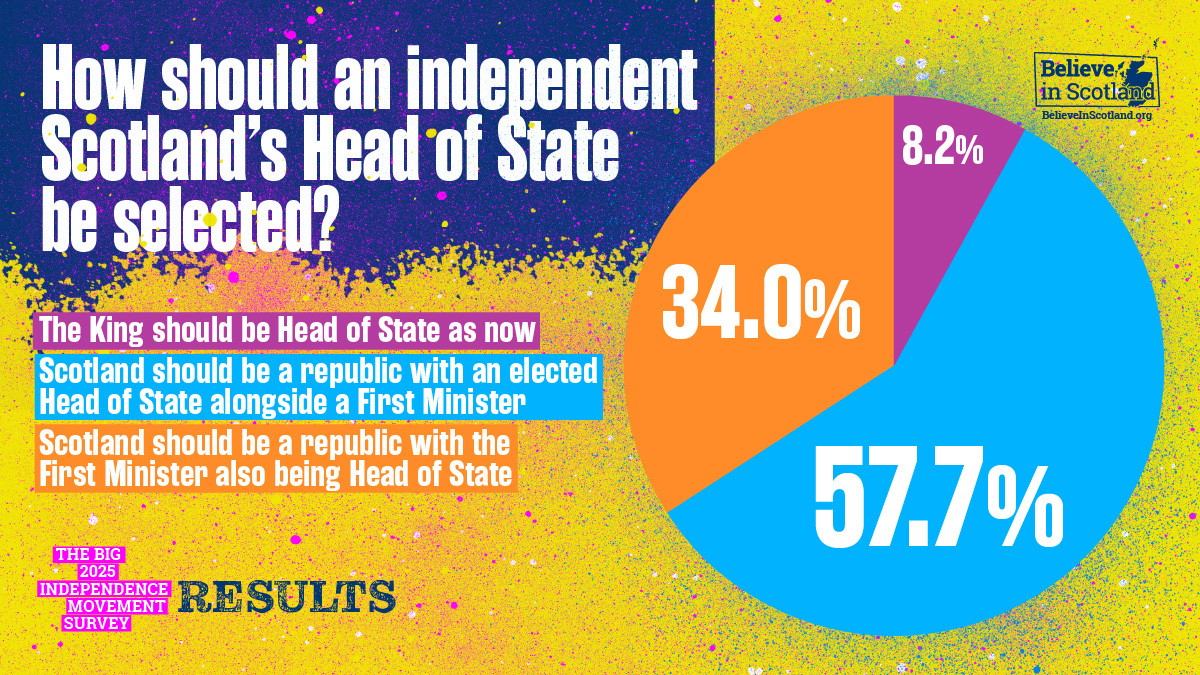
We asked: How should an independent Scotland's head of state be elected? Very few people think we should continue with the status quo where King Charles lll has a symbolic role as a constitutional monarch. Just over 8% answered that: “The King should be the head of state as now”.
Most say Scotland should have both an elected head of state (potentially a president) and a First Minister
More than half of our survey respondents, 58%, said Scotland should be a republic with an elected Head of State alongside an elected First Minister.
This is the situation in Ireland, for example. There, the people directly elect a President who serves for a term of seven years, and a maximum of two terms. The President is supposed to support the constitution of Ireland and has some powers, but the role is largely ceremonial.
The current President of Ireland is Michael Higgins, a broadcaster, poet and fluent Irish speaker as well as a politician. He uses his role to speak up for social issues such as equal pay for women and also to promote the Irish language and culture.
An another example is France which has both a President and a Prime Minister. The presidency is very powerful, due to the 1958 constitution of the Fifth Republic, which was established by the Second World War leader Charles de Gaulle. The French President - currently Emmanuel Macron - can make international treaties and declare war. He also appoints the PM, who must be from the largest party. The PM - at the moment this is François Bayrou - is not from Macron’s party which means Macron will struggle to get his domestic policies through Parliament. However, many argue that the French president has too much power and that Parliament should have more.
These international examples show that an independent Scotland would have real choices when it comes to having both a First Minister and an elected head of state but Ireland’s system of a directly elected, largely symbolic president may offer a more democratic model, ensuring fairness and accountability.
Some think one person could take both roles
A third of survey respondents, 34% chose the option “Scotland should be a republic with the First Minister also being the Head of State”. That is the case in the US, Mexico and Argentina.
The President of the USA is both the head of state and the head of government. They are also Commander-in-Chief of the army and have significant executive powers.
Trump has used these powers several times since taking office earlier this year. Most recently, he ordered military strikes on Iran which did not have the backing of international law. He is supposed to go to Congress to get approval after doing something like this but he has not.
The spectacle of President Trump acting without the support of the elected houses may put people off this option.
Conclusion
Our survey shows that independence supporters overwhelmingly want Scotland to elect its own head of state. That would give Scots the right to elect someone with a genuine connection to Scotland who can use the role (in whatever capacity it takes) to speak up for Scotland and its people.
Independence offers the opportunity to create modern, democratic institutions that reflect Scotland’s values.
