What an independent Scotland can learn from Finland
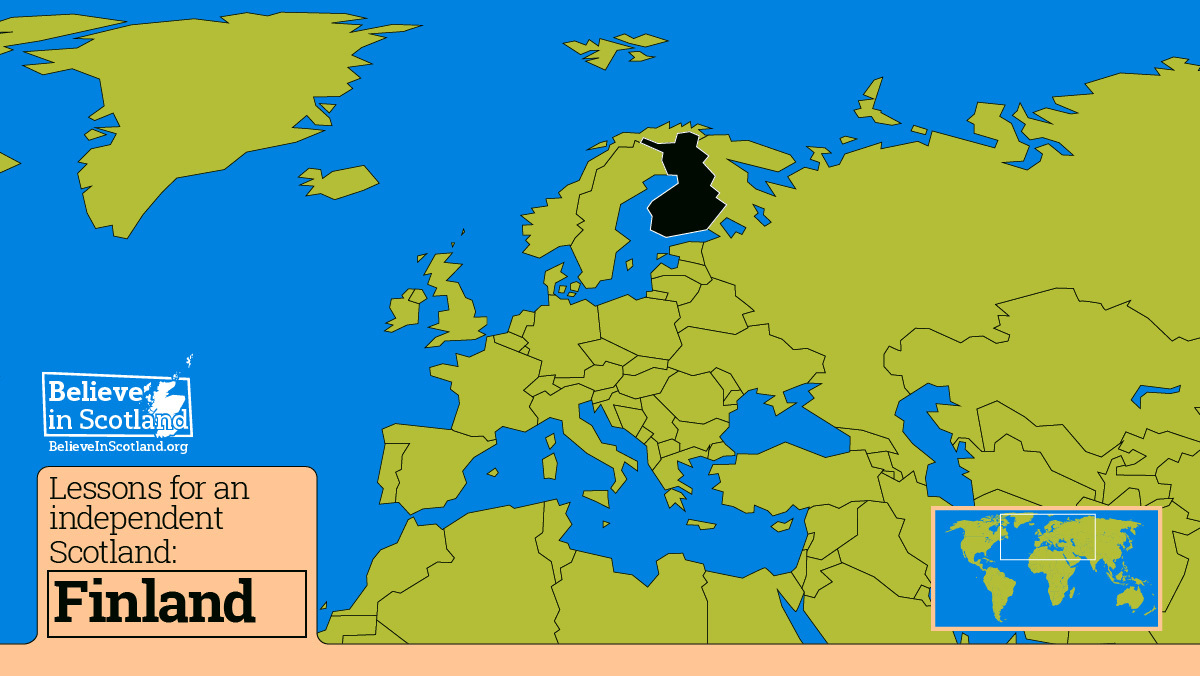
Finland has a population of 5.6 million, similar to Scotland, but its land mass is about four times Scotland’s size. Finland is a member of the European Union, and it is the only Nordic country to use the Euro. Unlike Scotland, it has a place at the EU’s top table, the Council of Ministers, where it plays a highly influential role.
Famously, Finland has topped the World Happiness Index (WHI) for the last eight years. Scotland does not have its own listing on the WHI, but the UK is low down the table, at number 23. Finland’s President Alexander Stubb, is a vocal opponent of Russia's invasion of Ukraine, has committed Finland to joining NATO and plays a leading role in world affairs, pushing Donald Trump to support Ukraine and to listen to other Russian neighbours on how to deal with Russia.
Whether you agree with his positions or not, that demonstrates that a nation with a medium-sized population can have a significant role to play in world affairs.
Here we pick out just two key areas from many where an independent Scotland should learn from Finland.
- Land ownership - Finland’s land ownership is one of the broadest in the world, giving it a strong foundation for a more equal society.
- Energy policy - the Finnish government is speeding towards net-zero, thanks to an innovative energy policy that rewards the areas where renewable power is produced. It doesn't just charge consumers more like the failed UK system.
1 - Land ownership
In Scotland, half of all privately owned rural land is held by just 433 people and companies. It has one of the most unequal land ownership in the developed world.
Finland in contrast has one of the most equal:
- Apart from some hot spots like central Helsinki, housing is comparatively affordable - to rent or buy. About 7 in 10 families own their own home
- About 800,000 people own a summer cabin or what Scots might call a but and ben.
- About 600,000 individuals and families own almost half of Finland’s vast forests. The state owns much of the rest, with companies accounting for less than ten per cent.
Ruled by Sweden for 600 years and then for a century by Imperialist Russia, land rights were contested. In 1914 widowed mother of three Ilma Lindgren was told by a landowner to hand over berries she had collected in the forest. She went to court and eventually the Supreme Court ruled in her favour, protecting every person’s right to roam and forage in the forest - that’s a right that Finns still hold dear today.
Finland declared independence from Russia in 1917, at the height of the Russian Revolution and was briefly engulfed in a bloody conflict. About a quarter of Finns were landless peasants or tenant farmers at that time and most were on the side of radical reform. In 1918, the newly independent Finnish government passed laws to let tenants buy the land they farmed at favourable rates. Next, the government set about buying up more land and reselling it to smallholders.
In the aftermath of the Second World War, about 11% of the Finnish population was displaced and became homeless and landless. The government embarked on a new wave of land redistribution. It created 250,000 new crofts or smallholdings.
This had its challenges - many of these plots were too small to provide a decent living for a family. Expectations were changing and in the latter part of the 20th century, Finland suffered from rural depopulation, like other countries, as young people moved to cities.
New policies - known as “Smart Shrinkage” are designed to help rural communities to adapt. In the autonomous region of the Åland islands, the Finnish government has also recently restricted who can buy homes.
But even without living full-time in the countryside, the citizen-owners of Finland’s forests still keep their links with their forest plots and benefit from the timber trade, receiving income that helps many families to maintain financial security. Timber and its byproducts are used to make biofuel, which is Finland’s major source of renewable energy.
That’s very different in Scotland, where profits from industries based on Scotland’s natural resources flow to the super-rich or multinational companies.
2 - Innovative energy policy that rewards power-producing areas
Finland has the third-least expensive commercial energy in the developed world and the UK has the most expensive.
Hydropower, bioenergy from forestry, wind power and new clean technologies such as hydrogen and smart-grid systems are boosting the economy and helping Finland accelerate towards a 2035 target to be carbon neutral.
Finland has historically burned peat and still does - it provides about 4% of their energy but this is being rapidly phased out for environmental reasons. They also use nuclear energy, unlike Scotland and Norway they didn’t have oil and gas resources so they went down the nuclear route and have continued to make that part of their mix. That’s their choice. In contrast, Scotland stands to be forced to take nuclear plants it doesn’t want or need to supply power to England.
Finland is also currently building green aluminium and green steel plants which will make good use of cheap renewable power. This year, it launched the world’s largest sand battery. (Excess renewable energy is used to heat sand to very high temperatures where it can be stored for months.)
Finnish communities embrace these projects because they see a real benefit. The Finnish government reallocates taxes raised from renewable energy production to the municipalities where the energy is created.
In 2024, 33 municipalities in Finland saw over 20% of their property tax revenue come from wind and solar farms. The largest share was in Simo, where approximately 69% of property tax revenue in 2024 was generated by wind farms.
Finland offers tax credits and grants to businesses to help with the green transition. Unlike Scotland, it has been able to draw on the European Investment Bank for support and it got £2.5 billion in 2024. The Finnish government also has a fifty per cent stake in the national power company which means it can ensure energy prices remain low for citizens and businesses.
Conclusion
With an 830-mile border with Russia, Finland is now a NATO “front-line state” and is raising defence spending accordingly. Finland is regarded as influential in the EU, especially when it comes to defence, digital policy and finance.
Finland has one of the best pensions in the world, lower child poverty and is a more socially equal society than the UK. In 2023, Finland elected a centre-right coalition under Petteri Orpo on a debt-reduction platform; welfare cuts have been contested but some have gone ahead. Even so, child-poverty rates remain far below Scotland or the UK’s.
Finland controls its own resources and has all the levers of an independent country. Under devolution, Scotland can make small changes to land ownership but not much more. Scotland can’t redesign primogeniture (the way estates are handed on generation after generation) as France has, alter capital gains tax or inheritance tax, or many other rules. It also lacks the borrowing headroom to fund large-scale public buyouts.
Finland has also shown how control of energy resources and policy are the basis for creating a fairer society. Finland makes the most of its energy resources. Meanwhile, the UK punishes renewable-rich Scotland with energy policies that make power more expensive in Scotland than anywhere else in the developed world.
When Scotland is independent, it will be able to change that and ensure that the country’s natural resources of land and energy are used to benefit Scotland’s people.
