Momentum is growing for the break-up of the UK
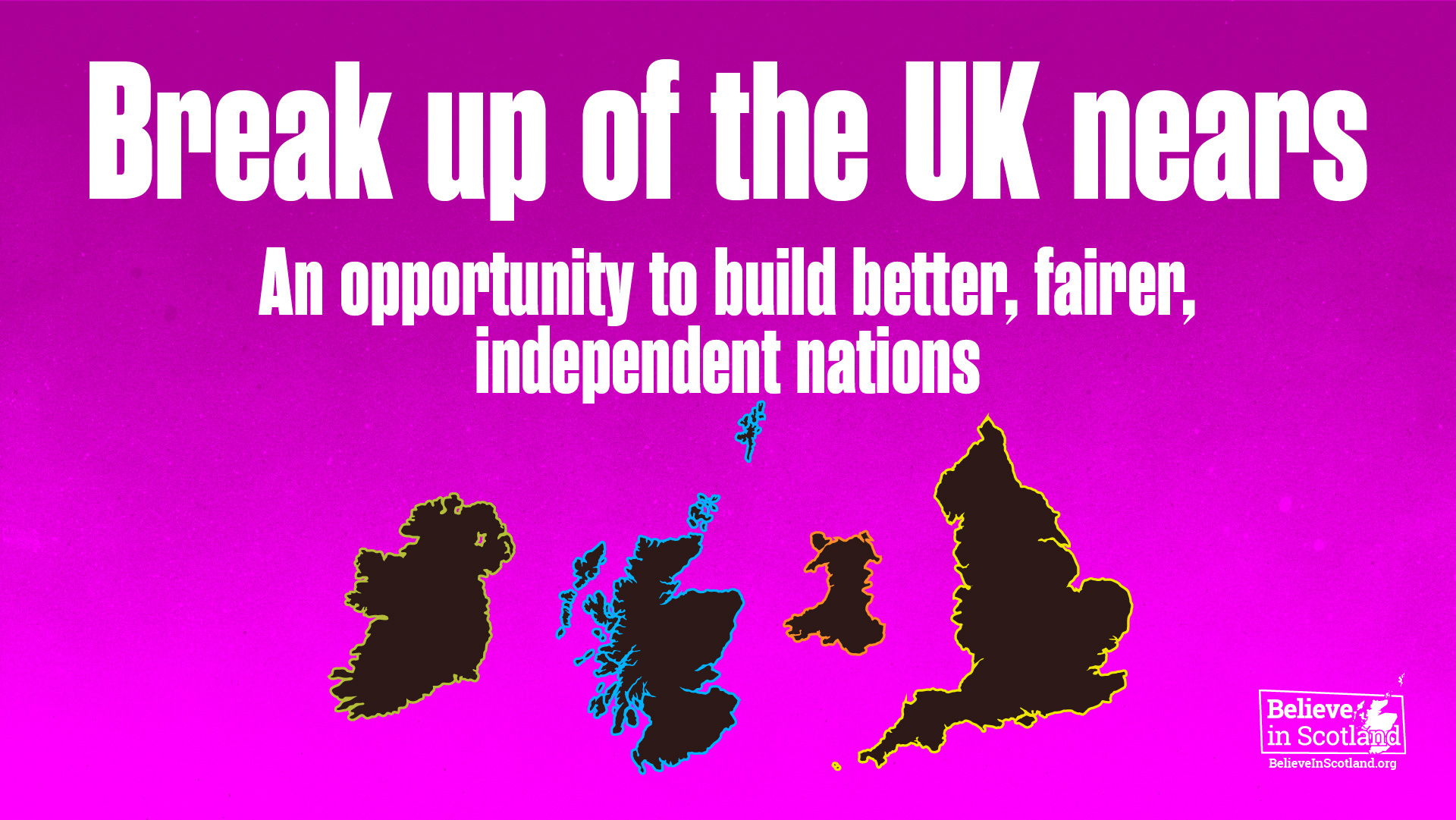
The Unionist UK media may be attempting to ignore it - but momentum is growing for the break of the UK and the change to a brighter future.
Instead of a centralised state in London setting policy for its benefit, the archipelago will be home to four strong, independent countries that can work together on shared issues.
Even within England, there is a push for change with Kernow - or Cornwall - Council voting to push for recognition as a Celtic nation within the UK.
Here we look at some of the forces pushing towards change:
1 - Northern Ireland is moving towards support for unification
The Sinn Féin First Minister of Northern Ireland, Michelle O'Neill and her party leader, Mary Lou McDonald, met with international diplomats at Westminster to discuss the future of Northern Ireland. A clip of McDonald on Good Morning Britain has been widely shared.
Meanwhile, a game-changing report has revealed that the cost to Ireland of absorbing Northern Ireland has been greatly exaggerated. The real cost would work out as less than 1 per cent of the island’s GDP for the first year - easily affordable for Ireland.
It would also create opportunities for growth - Northern Ireland would be in a better position to achieve the same levels of prosperity, health and educational outcomes as in the south. Unification offers opportunities to those living on both sides of the border, the report’s author, John Doyle, told a popular Irish podcaster.
Polling shows a strong trend towards support for unification. Younger age groups are much more supportive of unification, and the strength of opposition is also declining.
Since Brexit was enacted in January 2020, more Irish passports than UK passports have been issued every year in Northern Ireland. Specifically, 48,911 Irish passports were issued compared to 48,555 UK passports in that year. This trend is increasing with 117,998 Irish passports issued in Northern Ireland in 2024, marking a 3.9% increase compared to the previous year. The UK government has not said how many British passports were issued.
Brexit has also created trade barriers between Northern Ireland and the UK. Every time the EU adopts new rules or modernises old ones and the UK doesn’t, it gets harder for businesses to trade across the Irish Sea. The Labour government is proposing that it unilaterally adopts dynamic alignment with the EU to minimise these barriers but that faces English opposition, In the meantime - these non-tariff barriers are real and increasing.
These are just some of the forces pushing the dial on Irish unification.
2 - A majority support an independent Wales back in the EU
Wales has suffered from the UK’s centralised economic policy and often lost out on resources - such as infrastructure spend. The UK government annoyed many in Wales by claiming, for example, that HS2 counted as infrastructure spend for Wales.
They suffer in a similar way to Scotland from the fall out of energy privatisation. Like Scotland, Wales is a net exporter of electricity. But it doesn’t see any benefit - bills are high and the profits go to shareholders and to energy firms owned by other countries.
Poverty is high, especially among families and Wales’ Bevan Foundation is calling for Wales to emulate what Scotland is doing as a powerful and effective way to lift children out of poverty.
Polling on independence in Wales is sporadic, with only two polls conducted since Keir Starmer became Labour leader, but they show support for independence at historic levels. That poll, conducted in March, showed 35% backing independence, 50% against, and 15% undecided. Excluding the undecideds, that translates to 41% in favour, just 1% shy of the highest-ever figure recorded during the peak of the Covid pandemic.
And when asked whether they would back independence if it meant rejoining the EU, 51% said they would, a first for any Welsh independence poll to show a majority, albeit a conditional one.
Notably, support is strongest among younger voters, with 72% of 25-34-year-olds saying they would vote ‘Yes’ to independence.
Polling shows that Plaid Cymru has a good chance of being the largest party in the Senedd at next year’s election, overturning a century of Welsh backing for Labour.
3 - Almost three in four Scots say the UK will end within a decade
In Scotland, the long-term trend is firmly towards support for Scottish independence. When polling on this question started in the late 20th century, support was below 15%. The trend is obvious in this Ipsos Mori graph here, which starts in 2012, around the time the first independence referendum was agreed.
It is also the case that among voters aged under 45, there is a strong majority for independence. Academics generally don’t see this as a “lifecycle phenomenon” where people are likely to change position as they grow older.
Last year, Believe in Scotland got the reputable pollster Norstat to ask: “If Scottish independence meant that Scotland would be a republic - meaning the King would no longer be the head of state, so Scotland’s governance would be fully democratic and not a monarchy - how would you vote if there were an independence referendum tomorrow?” The answer was 59% for “Yes”.
The same effect is seen if people are asked how they would vote if Nigel Farage becomes Prime Minister of the UK - six out of ten say they would back independence.
Even people who don’t wish for independence think it is coming. Almost two-thirds of Scots say the UK will break up within a decade, and half think it will take just five years, according to polling by Ipsos Mori.
4 - England’s political choices are pushing towards the break-up of the UK
England is a very centralised and unequal country. Poverty in the north east and in the south west is very high, particularly among children. England’s regions have some of the highest levels of child poverty in Europe, higher even than poorer countries.
That is a result of London-centric policies that don’t help the regions. These pressures were cited by Kernow Council (Cornwall) when it voted to adopt the status of the UK”s fifth country earlier this week.
Brexit has increased the momentum towards the break-up of the UK. Over time, the Brexit effect is strengthening, with barriers to trade between the UK and Northern Ireland increasing.
Brexit was forced on Scotland despite a united vote by the country to remain in the EU. Since then the damage to Scotland’s economy, and the opportunities and life chances of its citizens has grown.
The UK Supreme Court judged that Holyrood does not have the power to hold a new independence referendum - even if the Scottish people elect a pro-independence majority as they did at the last election.
The reason they gave for this was that “democratic sovereignty” for Scotland lies with Westminster, where the House of Lords have more than half of the seats. Scotland has just 3% of seats in a largely undemocratic Parliament where most members are appointed for opaque reasons.
But there is no political will in England to replace the House of Lords with a Senate where the other nations could be represented and treated as equal partners. Decisions like this are pushing towards the break-up of Britain, as many constitutional experts acknowledge.
Conclusion
So far, the London-centred UK media is complacent or in denial about the increasing momentum for change. But it is time that the Westminster establishment faces facts and starts to plan for a post UK future.
Irish unification is approaching. There will be a border poll at some point. As to when, the dial is moving fast in terms of changing levels of acceptance of that among the Unionist community, especially among the young. Support for Scottish independence continues to often poll upwards of 50% and support for Welsh independence continues to rise.
Post the break up of the UK, the nations of the archipelago will have to continue to work together and co-operate. It is time that all those nations start to take that post-independence future more seriously.
